Poker Online: How to Play, Understand the Rules and Choose the Right Game
Last updated: June 2025 · Reviewed by the iGaming Bangladesh editorial team

Last updated: June 2025 · Reviewed by the iGaming Bangladesh editorial team
"For the Bangladesh audience, where local sports culture deeply respects statistics and game tactics, online poker becomes a natural extension of analytical thinking. Our position is clear: you must understand the rules, manage your limits and respect the risks before you place your first bet. Education first — then play." — Nadia Farzana Haque, Editor-in-Chief, iGaming Bangladesh
In this guide you will learn:
In the context of responsible gaming and sports analytics, understanding the structure of cards and betting rounds protects users from reckless financial losses. Below is a detailed knowledge base for a safe, informed entry into the game.
Disclaimer: This article is for general informational purposes only and does not constitute financial or legal advice. Online poker for real money is available only to persons aged 18 or over in jurisdictions where it is permitted by law. Always set deposit limits and play responsibly.
Poker is a family of card games built on incomplete information. Winning depends on mathematical probabilities, strategic betting and the ability to read opponents' actions. The online format is chosen for its low barrier to entry, free-practice options and the absence of pressure you might feel from live opponents sitting across the table.
In the classic format, the game revolves around a standard 52-card deck. The winner is the player who assembles the best five-card hand — or forces everyone else to fold. Today poker is increasingly associated with the digital environment, because internet platforms automate routine tasks and let you concentrate purely on decisions. That shift matters more than it sounds.
The accessibility of online poker has driven a structural change in the industry. After the "Moneymaker effect" of 2003 (Chris Moneymaker's WSOP Main Event victory) and the surge in traffic during the 2020 pandemic period, the majority of recreational players permanently migrated to virtual rooms. The audience is drawn to playing poker for entertainment, for developing cognitive skills, and — let's be honest — for the fun of outsmarting opponents from the comfort of home.
"An econometric analysis of millions of online tournaments showed that past player results significantly predict future outcomes, confirming a substantial skill component." — NBER Working Paper, "Is Poker a Game of Skill or Chance?" https://www.nber.org/papers/w17023
Online platforms run on software that manages a Random Number Generator (RNG), table seating and the player pool. The electronic format allows dealing approximately 90–100 hands per hour at a single table, while live games are limited to about 30 hands per hour. That is roughly three times the volume — and three times the learning speed.
"Online tables deal roughly 90–100 hands per hour thanks to automated shuffling, whereas live games average around 30 hands per hour." — "Second Session at the Virtual Poker Table", Journal of Gambling Studies (2013). https://doi.org/10.1007/s10899-013-9439-3
This speed difference radically accelerates the learning curve. A player at a computer or smartphone faces a far greater number of situational decisions per session. The ability to enter a game instantly, combined with the automation of processes like moving chips and calculating the pot, reduces the cognitive load on basic elements. You can move more quickly to mastering the mathematics and psychology of the game — which is, frankly, where the real fun begins.
Key motivators for newcomers include access to free games, low-stakes tables, the absence of social pressure and the fast pace of play. Survey data from gambling regulators confirms that most recreational online poker players value convenience and entertainment over the financial component.
"Among dual-mode players (both online and offline), 42.4 % cited enjoyment and entertainment as their primary motivation, not winning money." — 2023 Pennsylvania Online Gambling Report. https://www.pgcb.pa.gov/files/publications/2023_Interactive_Gaming_Annual_Report.pdf
Users want to test the waters with minimal barriers. Platforms address this need through freeroll tournaments and play-money tables, allowing beginners to acquire foundational skills without any investment. In projects linked to the company's starter educational guides at iGaming, we consistently see that players who start by familiarising themselves with the interface in demo mode develop significantly better habits before committing real funds. It is a small step that pays off disproportionately.
Comparison of Offline and Online Poker Environments
| Criterion | Offline (Live Poker) | Online Poker |
|---|---|---|
| Accessibility | Limited by location and venue hours. Requires physical presence. | Available 24/7 from any device in regulated regions. Instant start. |
| Table Format | One physical table. Eye contact, physical cards and chips. | Virtual tables with multi-tabling (playing several tables simultaneously). |
| Speed of Play | About 25–35 hands/hour due to manual shuffling and live interaction. | 90–100 hands/hour thanks to automation. Ideal for building volume. |
| Learning Curve | Slow. Players can discuss hands, but building volume takes years. | Rapid, because of the huge number of hands dealt and built-in interface hints. |
| Free Practice | Virtually non-existent outside home games for fun. | Abundant Play Money tables, demo modes and freerolls with zero financial risk. |
Takeaway: The digital environment drastically lowers entry barriers, delivers a faster pace and offers safe training modes — making it the natural starting point for anyone curious about the game.
The mandatory rules that every player must learn before sitting down include hand rankings, understanding the available actions during betting rounds and the structure of forced bets. Without this foundation, any wager becomes a blind lottery. And nobody enjoys a lottery they do not understand.
Cards are dealt clockwise starting from the dealer position (button), which shifts one seat to the left after every hand. This rotation ensures fair distribution of positional advantage. According to the Poker Tournament Directors Association (PTDA), this mechanism prevents any player from permanently holding the dealer role, maintaining game integrity. Proper play requires control of your chips and precise calculation of your actions on every street.
A standard 52-card deck is used. The win logic is built on the hierarchy of hands, from High Card (probability ≈ 50.1 %) up to Royal Flush (probability ≈ 0.00015 %).
"Standard poker uses a 52-card deck; hands are ranked from High Card to Royal Flush — a universal standard for all Hold'em variants." — How to Win at Poker Online, Open Textbook Library. https://open.umn.edu/opentextbooks/textbooks/how-to-win-at-poker-online
Complete Hand Rankings (lowest to highest):
| Rank | Hand | Example | Probability (5-card) |
|---|---|---|---|
| 1 | High Card | K♠ 9♦ 7♣ 4♥ 2♠ | ≈ 50.1 % |
| 2 | One Pair | 8♠ 8♦ K♣ 5♥ 3♠ | ≈ 42.3 % |
| 3 | Two Pair | J♠ J♦ 4♣ 4♥ 9♠ | ≈ 4.75 % |
| 4 | Three of a Kind | 7♠ 7♦ 7♣ K♥ 2♠ | ≈ 2.11 % |
| 5 | Straight | 5♠ 6♦ 7♣ 8♥ 9♠ | ≈ 0.39 % |
| 6 | Flush | A♠ J♠ 8♠ 6♠ 2♠ | ≈ 0.20 % |
| 7 | Full House | 10♠ 10♦ 10♣ 4♥ 4♠ | ≈ 0.14 % |
| 8 | Four of a Kind | Q♠ Q♦ Q♣ Q♥ 5♠ | ≈ 0.024 % |
| 9 | Straight Flush | 6♥ 7♥ 8♥ 9♥ 10♥ | ≈ 0.0014 % |
| 10 | Royal Flush | 10♠ J♠ Q♠ K♠ A♠ | ≈ 0.00015 % |
Probabilities are for a random 5-card hand drawn from a 52-card deck (University of Alberta poker probability tables; World Series of Poker official rules).
The table serves as the central arena for decision-making. For playing poker it is critically important to understand how your starting cards relate to the community cards on the board. In community-card games you evaluate not only your own hand but also the board texture — inferring which combinations your opponents might realistically complete. That inference, more than anything, separates a thoughtful player from a passive one.
Betting rounds determine how and when players commit chips to the pot. Every effective bet is a responsibility that requires the player to understand their own odds of success.
During betting the following actions are available:
Each player must decide which of these five actions best serves their hand strength and position. The decision is never purely mechanical — it involves reading the table, estimating pot odds and managing your stack size relative to the blinds.
"A tracking study found that an average session loss exceeding €1.70 and more than 60 sessions per month are statistically significant markers of problem gambling." — "Tracking Online Poker Problem Gamblers", Journal of Gambling Studies (2013). https://doi.org/10.1007/s10899-013-9439-3
Responsible-play notice: The information above is general in nature and does not replace consultation with a responsible-gaming specialist. Poker involves financial risk; set your limits before you begin playing.
| Term | Meaning |
|---|---|
| Blinds | Forced bets posted before the deal: small blind and big blind. |
| Stack | The total chips a player has at the table. |
| Board | The community cards dealt face-up in the centre (flop + turn + river). |
| Pot | All chips bet during the current hand. |
| Showdown | The moment remaining players reveal their cards to determine the winner. |
| Button (Dealer) | The marker indicating the nominal dealer position; rotates one seat left each hand. |
| Equity | Your mathematical share of the pot based on the probability of winning. |
Common Beginner Misconceptions — Fact-Checked:
Texas Hold'em dominates the market, accounting for roughly 75 % of all open cash tables and tournaments. To play this format, you receive two private cards (hole cards) and build the best five-card hand using any combination of your cards and the community cards on the table. Simple to describe, endlessly complex to master.
"Most professional online players specialise in No-Limit Texas Hold'em — because of the depth of available training tools and the accessibility of player pools." — Newall & Talberg, Qualitative Study of Elite Online Poker Players (2023). https://doi.org/10.1007/s10899-022-10159-3
Its widespread popularity makes Hold'em the most commonly found poker game in any online lobby. Hold'em concentrates the largest volume of educational materials, statistics and software tools available to learners. The game's no-limit structure demands high financial discipline and caution when selecting starting hands — because a single careless preflop call can haemorrhage chips before you even see the flop.
A hand begins with the posting of forced blind bets (small blind and big blind). Players then receive two private cards, and the decision-making phase begins.
Action moves clockwise around the table. The Hold'em format includes four betting rounds:
"In Texas Hold'em, after the preflop round three community cards (the flop) are revealed, followed by one on the turn and one on the river — four betting rounds in total." — How to Win at Poker Online, Open Textbook Library. https://open.umn.edu/opentextbooks/textbooks/how-to-win-at-poker-online
On each street, the player weighs the strength of their hand against the visible portion of the board and the actions of opponents. This is where playing poker becomes genuinely engaging — every new card reshuffles the probabilities.
After the river, if two or more players remain, a showdown takes place: cards are revealed, and the highest-ranking five-card combination wins the pot.
To make the mechanics concrete, here is a simplified example:
This simple sequence illustrates the core loop: evaluate your hand, decide how much to bet, and observe how opponents react. Notice that Player C never needed to show their cards — the betting itself told the story.
Hold'em is the standard starting point because of the simplicity of its rules, the abundance of tutorial videos and the availability of free tournaments across virtually every online platform. Professional poker schools such as PokerStrategy and Upswing Poker build their beginner curricula around No-Limit Hold'em because it offers the largest player pool and the most transferable fundamental skills — ranges, position, preflop and postflop logic.
Newcomers gain free experience here most easily, since games run around the clock at every stake level. To keep things enjoyable, rooms offer extensive Hold'em-specific educational modules. We always advise users to master Hold'em preflop charts before moving to higher-variance formats with elevated risk. There is no rush. The games poker rooms offer will still be there tomorrow.
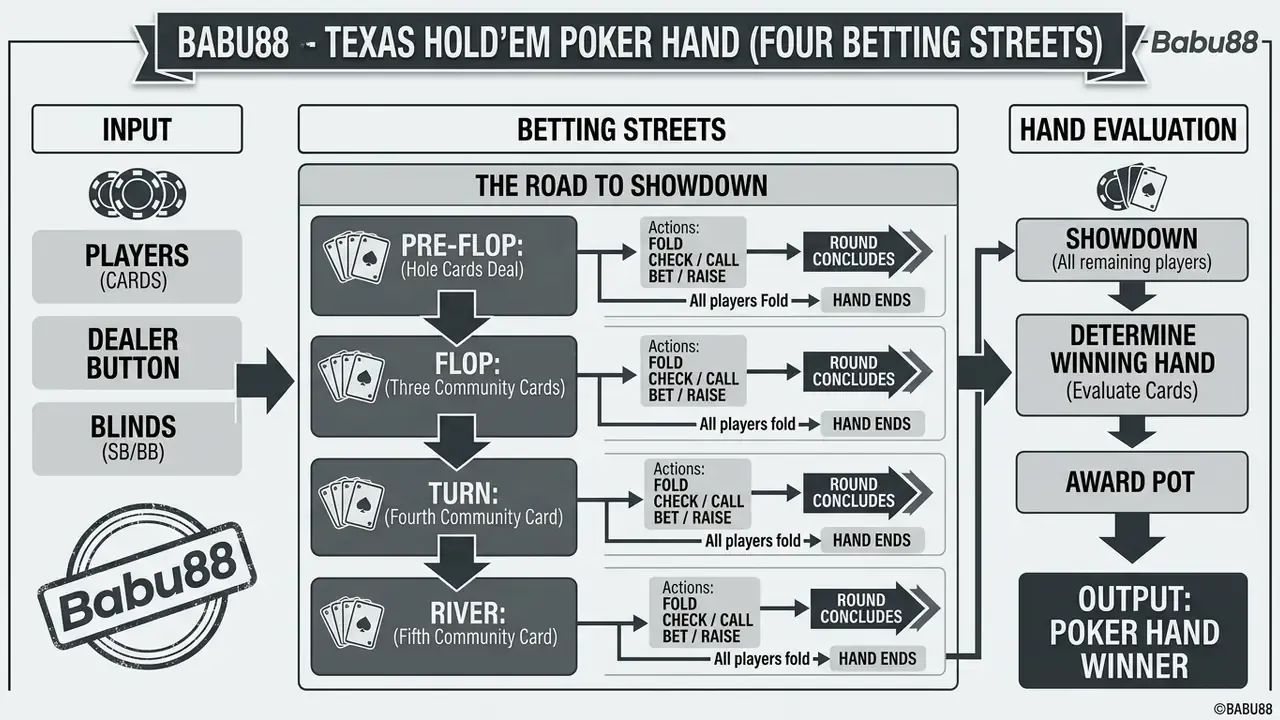
Semantic: SVG or HTML/CSS diagram in DOM; <figure> and <figcaption>; alt text "Texas Hold'em poker game deal flowchart".
Besides Hold'em, several other important format categories exist: tournaments, cash games, and alternative card variants such as Omaha, Stud and Draw poker. Your choice of format determines the pace of each session and the impact of variance on your bankroll.
"Online players on average play more sessions with higher outcome variability than live players — because of speed and multi-tabling capability." — Longitudinal Study "Poker Modality Trajectories", Journal of Gambling Studies (2017). https://doi.org/10.1007/s10899-017-9726-2
In a cash game, chips have direct monetary value and you can leave at any time. In tournaments, a player pays a fixed buy-in for a starting stack and plays until eliminated or victorious. Free formats typically mimic tournament structure, adding an element of competition and fun without financial exposure. The major game categories in online poker platforms allow you to find a table that matches your personal schedule and risk tolerance.
Popular online poker variants beyond Hold'em:
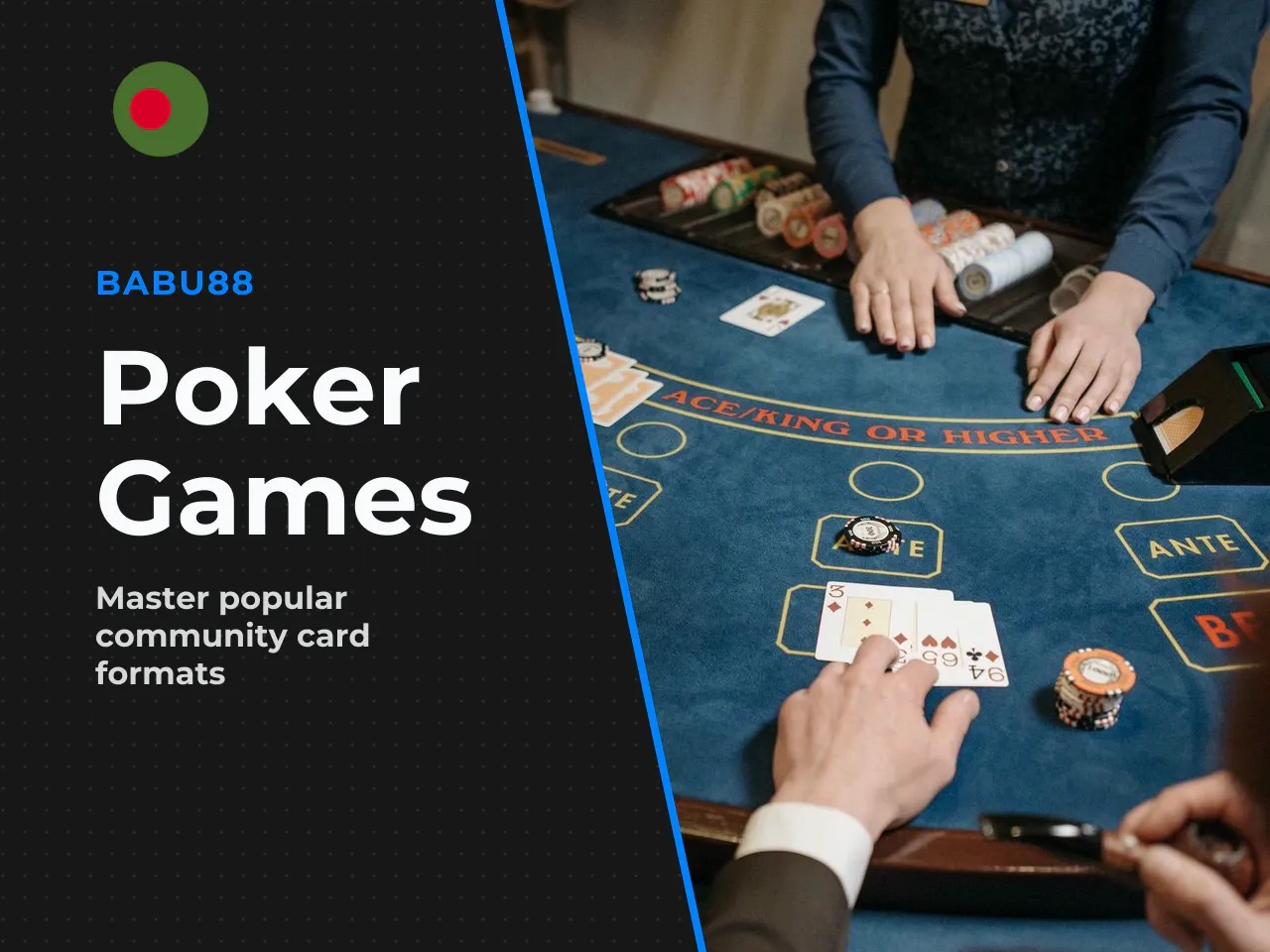
Games built on community cards — Texas Hold'em and Pot-Limit Omaha chief among them — dominate online lobbies. The presence of an open board stimulates analysis and bluffing, keeping the majority of players engaged at the table.
The key difference between Omaha and Hold'em is that the player receives 4 hole cards and must use exactly two of them together with three board cards. This structure makes Omaha a game with higher bankroll requirements and significant probability shifts across the streets. A hand that looks strong on the flop can evaporate by the river far more often than in Hold'em. Most professionals recommend staying within Hold'em until you have fully mastered the concept of table position during online sessions.
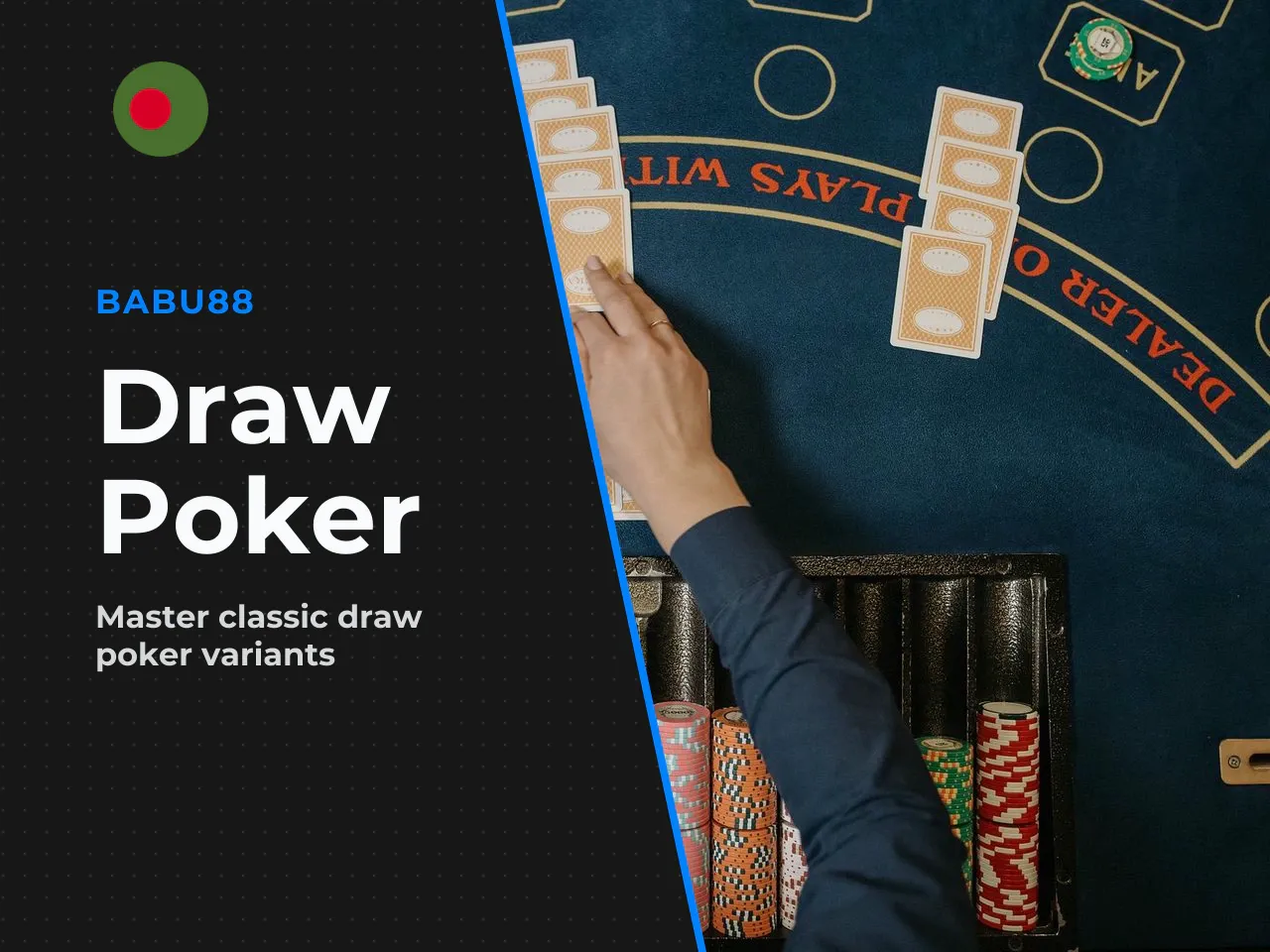
Draw games such as Five-Card Draw eliminate community cards entirely, relying solely on private hands. Players receive five cards and may exchange some of them to improve their combination.
The absence of a shared board fundamentally changes the decision-making process. The only information available is the size of opponents' bets and the number of cards they replaced. For experienced players, draw variants are attractive because of their relatively under-explored strategic landscape compared to Hold'em. For most players, however, draw games serve as an entertaining alternative rather than a primary format — a change of pace when Hold'em sessions start feeling repetitive.
Play Money mode and real-money play require fundamentally different psychological approaches. In free games, there is no fear of losing your bankroll. Even micro-stakes, however, instantly activate loss-aversion behaviour. The difference is not subtle — it is dramatic.
Coaches and trainers highlight the stark contrast: free tables breed chaotic play because losses carry no consequences. In contrast, even minimal real stakes make many players narrow their opening-hand ranges significantly. That tightening is healthy, but it can also trigger anxiety-driven mistakes if you are not prepared.
"70 % of players who transitioned from social casino games to real money cited the desire to win real money as their primary motivation." — BASIS Summary, Social Casino Motives Study (2022). https://www.basisonline.org/2022/09/social-casino-games.html
The transition should be made cautiously, understanding that cash games demand learning new emotional responses alongside new strategic ones.
Free mode is ideal for learning mechanics, room-interface buttons and basic mathematical probabilities. It fully satisfies the needs of a newcomer who simply wants to experience the game's emotions and test whether they enjoy the process.
In demo mode, focus on developing these four mechanical skills:
If your goal is simply to discover whether you like the game and are willing to invest time in learning, free options are entirely sufficient. Move further only when interface actions have become second nature. There is no prize for rushing.
Readiness for the transition is determined by strict adherence to bankroll management rules and solid knowledge of poker rules — not by results in demo mode. Winning streaks in free play can be misleading.
"A conversion study showed that users with high free-play frequency are significantly more likely to make a first real-money deposit, but this does not predict their profitability." — Reilly, "Conversion from Free Play to Cash Play in Skill-Based Games", Journal of Gambling Studies (2021). https://doi.org/10.1007/s10899-021-10062-3
Before depositing, a user must define a clear sum whose loss they consider the price of entertainment — nothing more. Players frequently lose their first deposit because of aggressive habits formed at free tables. At iGaming, we recommend that users set a hard stop-loss (loss limit) in the client's settings before making their first deposit. By completing this step, players protect themselves from tilt and begin treating each bet as a mathematically grounded decision rather than an emotional impulse.
A reliable online poker operator must first and foremost hold a licence from an authoritative regulator (e.g., the UK Gambling Commission — UKGC — or the Malta Gaming Authority — MGA) and guarantee the safety of funds through independent laboratory audits. Choosing a platform where you will play depends on legality, game variety and the number of active players at the tables.
"Licensed operators are required to implement age verification, geolocation and responsible-gaming tools — including deposit limits and self-exclusion." — 2023 Pennsylvania Interactive Gaming Annual Report. https://www.pgcb.pa.gov/files/publications/2023_Interactive_Gaming_Annual_Report.pdf
Licensed platforms commit to strict responsible-gaming requirements and data protection. Major operators such as PokerStars and GGPoker serve millions of registered users across dozens of regulated markets. A player should be able to join a game instantly and receive qualified support for any questions about deposits or RNG integrity.
If you intend to play poker for real money, you will need a convenient deposit and withdrawal method. Most licensed platforms support:
When choosing a method, check minimum and maximum limits, processing times and any fees. For players in Bangladesh and similar regions, mobile-friendly deposit options and apps that perform well on slower connections are particularly important selection criteria. A great poker room means nothing if you cannot get your money in or out smoothly.
Traffic determines the value of a platform: the more players, the easier it is to find a table at your preferred stake at any time of day. For beginners, having a large selection of micro-stakes tables is critically important.
"Major regulated operators maintain deeper liquidity at micro-stakes, providing stable seating for players across all time zones." — Patterns of Play, British Gambling Commission. https://www.gamblingcommission.gov.uk/statistics-and-research/publication/patterns-of-play
Diverse game options and an active pool of recreational and regular players guarantee that you will not end up one-on-one against a professional opponent due to a shortage of seats. Market leaders maintain high liquidity at foundational Hold'em limits, ensuring stable seating across all time zones. If a poker room's lobby looks empty at your usual playing hours, that is a clear signal to look elsewhere.
A quality room lets you register and quickly launch demo games without complex delays. Good platforms offer Play Money mode and built-in educational modules immediately after account creation.
Get started in 3 quick steps:
An important feature for a smooth start is Quick Seat (auto-seating), which spares the user from manually scanning a vast lobby for appropriate tables. It sounds like a minor convenience, but for a first-time player staring at dozens of unfamiliar table names, it removes a real source of hesitation.
Provider evaluation checklist:
The starting route in 2026 begins with downloading the client, passing KYC verification and selecting your first free cash table in the programme lobby. For a newcomer to succeed in online poker, the journey from theoretical learning to playing practice should be gradual — testing hands dealt at each stage rather than jumping straight into deep water.
Game selection should be deliberate. Resist the temptation to enter a large tournament immediately after depositing; the best choice for a beginner is micro-stakes cash games. The simplicity algorithm: registration → age confirmation (18+) → launch play-money mode → learn the mechanics → and only then activate real-money deposits with limits enabled. Each step earns you something the next step requires.
The simplest path to starting is to use the Quick Seat function, which selects the right poker game type and buy-in based on your filters. The system automatically seats you at an available table.
This feature eliminates the paralysis of choice. Transitioning to playing poker happens instantly. The only things required of the user are: assess your position relative to the dealer button, wait for the blinds to be posted, and click "Call" or "Fold" to integrate into the action. Within a few hands, the rhythm becomes intuitive.
The top mistakes at the start include playing more than 35 % of starting hands, ignoring positional strength and attempting hero-call bluffs at micro-stakes. Often, poor betting discipline is compounded by a simple lack of awareness of key poker rules.
As a practical guideline, most coaching platforms (PokerStrategy, Upswing Poker, Run It Once) agree: playing too wide a range of starting hands — beyond roughly 20–25 % from early position — leads to guaranteed long-term losses. Players also underestimate the value of acting in late position, missing 15–20 % of potential equity per hand.
Another frequent problem? An inexperienced player jumping too early from basic Hold'em into less predictable formats like Draw or Omaha, where a much deeper bankroll cushion is required for each bet. Master one format before branching out.
"Multi-tabling is an independent risk factor: players who consistently play at multiple tables simultaneously are significantly more likely to exhibit patterns of problem gambling." — "Tracking Online Poker Problem Gamblers", Journal of Gambling Studies (2013). https://doi.org/10.1007/s10899-013-9439-3
"The Online Poker Tilt Scale (OPTS) demonstrates that anger and impulsive play after bad hands are measurable constructs linked to risky betting and deteriorating results." — OPTS Validation Study, Journal of Gambling Studies (2014). https://doi.org/10.1007/s10899-014-9476-y
⚠️ Compliance Block and Responsibility
Always begin with free mode in your poker client. Carefully study the betting rules and hand rankings for your chosen format. Poker is a game built on high mathematical variance — even strong players experience losing streaks. Set a strict monthly deposit limit before transitioning to real-money play and never chase losses while on emotional tilt. The game is intended for persons aged 18 and over. If you feel gambling is becoming a problem, contact a responsible-gambling organisation such as BeGambleAware or GamCare.
Disclaimer: Online poker for real money is available only to persons aged 18 or over in jurisdictions where it is permitted by law. The answers below are for general informational purposes only.
The answers below address the most common questions from newcomers who want to enter online poker. A safe start should be accompanied by a basic set of legal and gameplay knowledge so that the experience remains enjoyable without unnecessary losses.
Yes. All reputable licensed platforms provide permanent access to free modes immediately after account creation. This is the cornerstone of a correct learning cycle before any real financial betting. Play Money mode acts as an excellent interface simulator, letting you practise in a protected environment while keeping the fun factor intact for your first steps in poker. You can play poker online for as long as you like without spending a single unit of currency.
At the beginning, the game is a balance between understanding the rules and having an enjoyable experience. Strategy develops later — and it develops naturally if you give it time. Without knowing the basic mechanics — what poker actually is — any strategy ceases to function.
"A 2024 neurophysiological study showed that regular online poker players demonstrate behavioural and neurophysiological decision-making patterns that are distinct from those of a control group." — "Impact of Online Poker Gambling on Behavioural and Neurophysiological Parameters" (2024). https://doi.org/10.1007/s10899-023-10258-3
For this reason, the best entry point in online poker today is learning the rules under zero budget pressure. Enjoy the process first. The strategic depth reveals itself gradually.
Based on community forums and beginner coaching threads, new players most frequently ask:
Readiness is signalled by objective benchmarks, not feelings of luck in free games:
When these criteria are met, a cautious first micro-stakes deposit — with a pre-set stop-loss — is a reasonable next step. Take it slow. The tables will be waiting.